
What’s Your Evaluation Personality? (And Why It Matters More Than You Think)
The instinct driving your evaluation strategy may be the thing undermining it

Four evaluators look at the same programme and design completely different studies:
One builds a dashboard.
One builds an RCT.
One builds a participatory process.
One builds a scaling plan.
All of them are competent. All of them are serious. All of them believe they are doing “good evaluation.”
So what explains the difference?
It’s not just training. It’s not just institutional incentives.
It’s instinct.
When you design an evaluation, what is your first question?
“Did we deliver what we promised?”
“Is the causal effect real?”
“Who benefits – and who doesn’t?”
“How do we make this work at scale?”
That first instinct reveals something important. Because evaluation is never neutral. Every evaluation design optimises for something.
Over time, that optimisation logic becomes a pattern – almost a personality.
Here are four archetypes I see again and again.
The Four Types
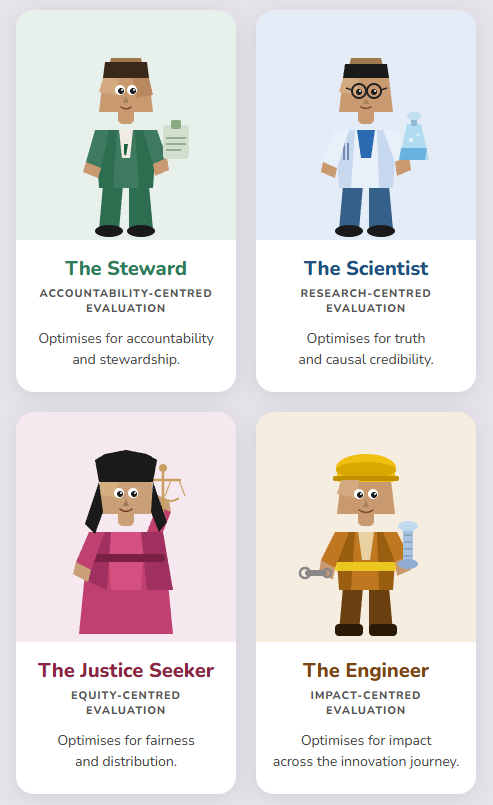
The Steward
Evaluation model: Accountability-Centred Evaluation (ACE)
Core question: Did we do what we said we would do?
Optimises for: Accountability and stewardship
Strength: The Steward protects institutional integrity. They ensure that public or philanthropic funds are used for their intended purposes. They reduce fiduciary and reputational risk. They reinforce procedural legitimacy and sustain trust in public institutions. In politically exposed environments, this function is indispensable.
Blind spot: Evaluations may demonstrate procedural compliance while leaving programme effectiveness unchanged. Reporting requirements are met, targets are documented, and governance systems appear robust – yet substantive outcomes may stagnate. In such contexts, compliance becomes an end in itself rather than a means to progress.
The Scientist
Evaluation model: Research-Centred Evaluation (RCE)
Core question: Is the effect real?
Optimises for: Truth and causal credibility
Strength: The Scientist raises the bar. They insist on internal validity, clean identification strategies, and protection against bias. They stop us from confusing correlation with causation and optimism with evidence. In fields prone to hype and wishful thinking, this discipline is invaluable.
Blind spot: Scientific incentives reward precision and publishability more than timeliness or decision relevance. Gold-standard studies may answer narrow causal questions while strategic choices are made elsewhere and earlier. Knowledge accumulates. Practice does not necessarily shift. A beautifully identified effect is of limited use if it arrives after the window for action has closed.
The Justice Seeker
Evaluation model: Equity-Centred Evaluation (ECE)
Core question: Who benefits – and who doesn’t?
Optimises for: Fairness and distribution
Strength: The Justice Seeker makes inequity visible. They disaggregate results. They centre marginalised voices. They challenge average effects that conceal unequal gains. They remind us that impact for some is not impact for all. In systems where power distorts evidence, this perspective is corrective and necessary.
Blind spot: They may generate powerful insights about inequity without a clear pathway to scaling or sustainability. Participation is strong. Representation is meaningful. But scaling pathways, fiscal trade-offs or political feasibility may remain underdeveloped. Structural reform requires not only diagnosis of inequity but mechanisms for altering incentives and behaviour at scale.
The Engineer
Evaluation model: Impact-Centred Evaluation (ICE)
Core question: How do we make this work – under real constraints – at scale?
Optimises for: Impact across the full innovation journey
Strength: The Engineer designs evaluation around decision points. They care about proof-of-concept – but also adaptation, implementation fidelity, scalability, and long-term sustainability. They treat every evaluation pound as borrowed from delivery and ask whether it generates returns in improved lives.
Blind spot: The Engineer can drift toward instrumentalism. Reach can be mistaken for value. Speed can crowd out reflection. When evaluation is tightly coupled to strategic ambition, there is a risk of privileging what can move quickly over what is normatively or empirically secure.
The Important Bit
Each archetype protects something valuable:
The Steward protects accountability.
The Scientist protects truth.
The Justice Seeker protects fairness.
The Engineer protects impact.
None of them is irrational. None of them is redundant.
But they do not optimise for the same thing.
The Twist
Here’s the catch:
Your evaluation strategy will drift toward your personality.
Not consciously. Not maliciously. But steadily.
If you’re a Steward, you will design monitoring frameworks.
If you’re a Scientist, you will design experiments.
If you’re a Justice Seeker, you will design participatory and disaggregated studies.
If you’re an Engineer, you will design evaluations around scaling and sustainability.
Organisations have personalities too.
Funders often exhibit Steward instincts.
Academics are incentivised toward Scientist logic.
Advocacy and community organisations frequently embody Justice Seeker priorities.
Innovation units and scaling organisations tend to require something like the Engineer.
None of this is wrong.
But when goals and evaluation personality diverge, friction follows:
A scaling organisation driven purely by Steward logic can drown in compliance.
A fast-moving policy reform driven purely by Scientist logic can wait too long for answers.
An equity-focused initiative driven only by Engineer logic may overlook distributional trade-offs.
Evaluation design reflects value commitments. And values shape strategy.
The Strategic Question
So the question is not: “Which personality is right?”
The question is: “What are we optimising for in this decision?”
If your primary aim is stewardship of public funds, you need Steward logic.
If your goal is advancing generalisable knowledge, you need Scientist discipline.
If your mission is reducing disparities, you need Justice Seeker vigilance.
If your ambition is to move from promising pilot to sustained, scaled impact, you need Engineer thinking.
The risk is not having a personality.
The risk is not knowing which one is driving your decisions – and leading yourself, and everyone around you, in the wrong direction.
The most strategic evaluation is not the most rigorous, the most compliant, or the most participatory – it is the one explicitly aligned with the outcome you are trying to maximise.
So – which evaluator are you?